Modernising the use of a dugout
(5 minute read)
The technical area is a highly visible space for both managers and players. Commonly referred to as the “dugout” in non-league football — or simply the “bench” for those not selected in the starting XI — it exists at every level of the game, from the Premier League right down to the local park.
But do we, as coaches and staff, truly maximise its potential?
Over Christmas I was watching Aston Villa and noticed they had embroidered quotes onto their dugout seats. It struck me as innovative — and potentially genius. As coaches, we ensure most areas of a training ground are filled with information or motivational messaging: club values painted on walls, hydration posters above urinals, set-piece reminders next to cutlery in the canteen, even mindset triggers on gym mirrors.
So why not the dugout?
Are we missing an opportunity to use this space to motivate, support, engage or challenge players and staff during the matchday process? I’m not sure who’s responsible, but most clubs make a conscious effort to design dugouts around their colours, with padded seating, structured layouts, and roofing. So why does that same attention to detail stop when it comes to football-specific accessories?
In Villa’s case, the initiative formed part of a new corporate partnership. Together with their sponsor, they selected messages from fans that embodied the club’s beliefs into the headrests of the dugout seats, where substitutes would sit. this was quite literally giving a new meaning to “fans getting behind you.” One read: “Believe in yourself, like we believe in you.” The design debuted in their 2–1 win over Arsenal on 6th December, with the winning goal coming from a substitute - fittingly.
I also know of another club that experimented with heated dugout seats, with staff explaining this helped keep substitutes warm and muscles primed for longer.
In my own role working with substitutes, we tried to empower the bench as much as possible. We wanted no part of the game-day experience to allow players to disengage. Personalised cue cards, terminology posters, and practical resources were all used to help players be effective finishers. The aim was simple: ensure they had everything they needed to impact the game and when they saw how deliberate we were approaching this minor part of a players preparation, a hope they would match our energy and ambition.
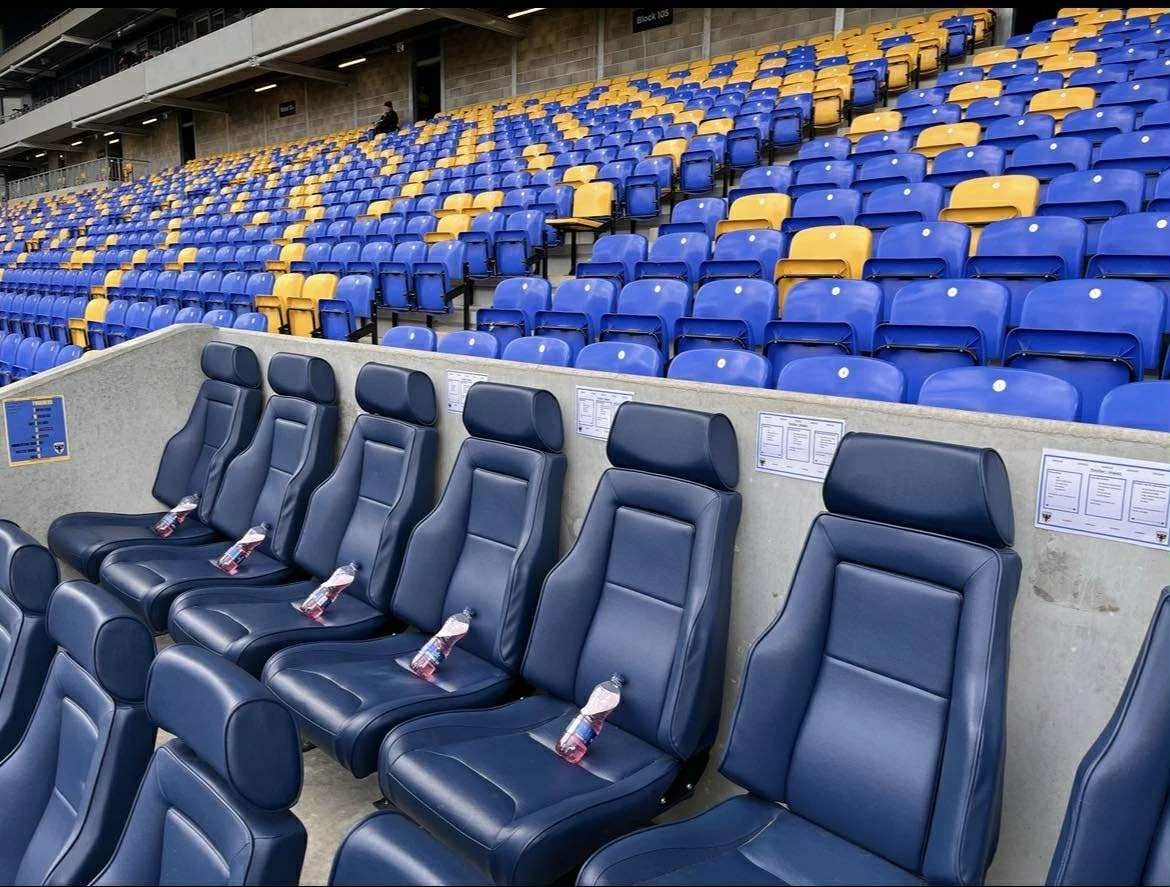
An early example from our attempts at afc wimbledon to make the dugout more empowering for the finishers
Each player had:
Their personalised Cue Card
Relevant Hyration (as confirmed with nutritionist)
poster with our finishers language at either end
I genuinely believe this space can be better utilised.
That said, there are considerations. During an away match at Wigan Athletic, I had designed our bench setup for the finishers — only for fans, separated by a thin concrete wall, to come within touching distance and photograph everything! While nothing sensitive was displayed, it highlighted the importance of balance: impactful, yes - but not exposing key information.
This leads to a wider question. Can dugouts also better support managers with in-game insights and communication?
Some evolution has already taken place. Tablets now provide instant replays, multiple camera angles, and set-piece clips for incoming players - a significant advancement compared to just a few years ago. But what’s next?
BBC Sport did an insightful piece recently around each managers habits in their technical area - I thoroughly recommend checking this out. With this sort of content being analysed, could it lead to more strategies implemented around a dugout to compliment each managers approach: Whiteboards pinned up in dugouts (media permitting, of course)? Opposition cheat sheets stuck on the back of seats? actual phone lines to create more efficient communication with analysts in the stands? live data dashboards to help analyse strength and weaknesses in performance?
Other sports have already embraced this kind of transformation. American Football and Basketball lead the way, treating their bench areas as tactical hubs rather than passive seating.
And with Thomas Tuchel recently suggesting he may keep players in changing rooms during the 2026 World Cup due to extreme heat, could this open a new avenue entirely? designating the technical area to a Purpose-built coaching hubs? subsequently allowing for the changing rooms to be equipped for ball work, specific warm-ups, live match feeds, or recovery tools? a potential limitation of this is the positioning of changing rooms in relation to the technical area - the act of a substitution becomes slower, but might also mean more preparation. I think it’s ipswich town whose dugouts are a 60+ second walk to the changing rooms.
It’s an open topic - but as clubs continue looking for marginal gains to enhance coaching and player experience in the search for the all important win, this feels like a space ripe for innovation.
The question is: who will move first?
I’ll certainly be raising it with the clubs I work with - so watch this space.
By Sammy Lander