When is the best time to take a corner?
(7 minute read)
I have long had an interest in set pieces and, while completing my substitution and referee work alongside my coaching badges, I have taken every opportunity to sit down with the set-piece specialist at each club and learn about their methodology.
After observing the level of detail that goes into analysing potential routines, along with the subtle but highly specific training strategies used throughout the week to give players direction in these moments, it became clear how much thought is invested in this area. Not only do I enjoy that level of detail, but it also led me to question: surely you would want to be just as deliberate with when these routines are deployed in a real match scenario?
This led me to explore: when is the best time to use a specific set-piece routine? Is it early in the game, before players’ recall of detail fades as the emotion and intensity of the match builds? Or is it later, when substitutions have been made - despite substitutes often following a less prepared process than starting players? is it better to use these detailed routines when attackers are fresh (knowing the defence might also be) or wait until defenders are fatigued (knowing the risk of attackers not recalling certain details). And how much do physical and mental fatigue influence this?
To begin, I analysed every successful corner to identify the minute in which goals were scored. The graph below breaks this down into 10-minute segments THROUGHOUT A MATCH.
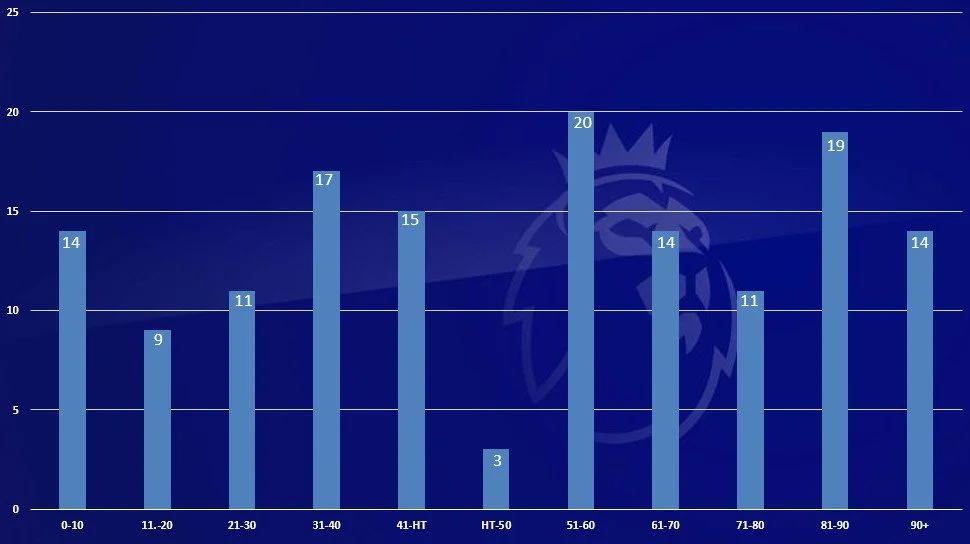
In the first half, the opening 10 minutes appear to be a fruitful period for teams to use a designated set-piece routine. This naturally aligns with when most teams take their first corners of the game. There is then a slight decline in the middle phase of the half (11’–30’), before another increase in successful corners in the final 15 minutes.
One particularly interesting period is between the 41st minute and half-time. On average, the first half includes around three minutes of added time, meaning this window is typically closer to an eight-minute segment. Despite this, it represents the fourth most productive period for goals from corners. Does this begin to answer some of the earlier questions? Do defending teams lose concentration towards the end of a half, or is this the result of accumulated physical fatigue in repeated duels?
This idea is somewhat supported by the second half, where the first full 10-minute segment is the most productive period for scoring from corners. Has half-time allowed for key details to be reinforced, clips to be reviewed, and players to mentally and physically reset?
Both halves appear to follow a similar pattern. However, in some matches, a team may not have their first corner until as late as the 80th minute. So while timing is clearly a factor, my next area of research was: which corner in the sequence is most effective?
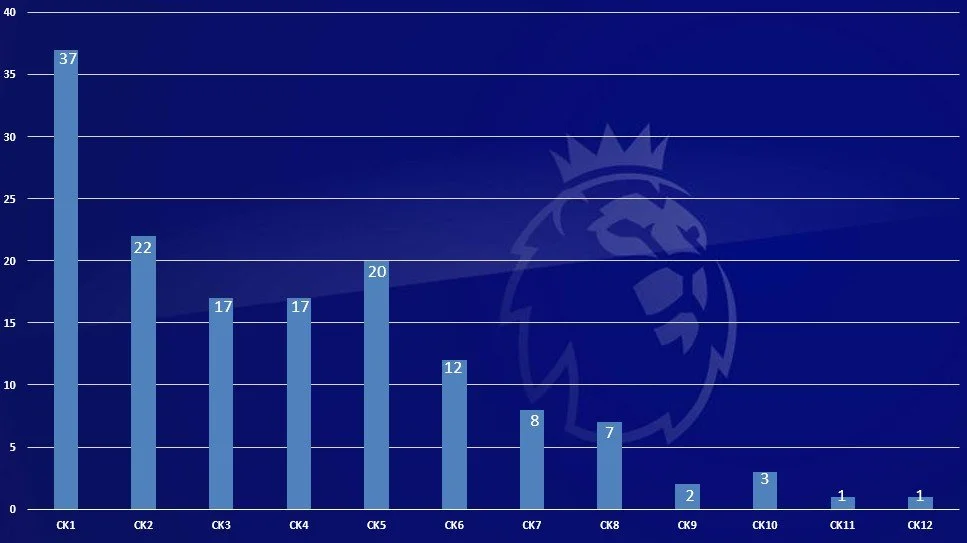
This proved to be even more revealing, highlighting a clearer pattern. The key takeaway: with each additional corner, the likelihood of scoring from a set routine appears to decrease.
With more time and data, it would be valuable to express these findings as percentages rather than raw totals. This would provide greater context and help answer further questions the data raises. For example: how many 13th corners have we had in the premier league? What percentage of first corners versus twelfth corners are successful? this might drive coaches to use more detailed principles in their first five routines, and go to more generic principles / routines after the sixth corner.
I may well revisit this analysis and release an updated version of this Gamechanging article once I’ve explored these questions further. It feels like an area that could generate even more questions than answers - but hopefully, this begins to contribute to the marginal gains that set pieces are increasingly providing across a season. At the very least, it should encourage more deliberate thinking around a detail we often take for granted.
For set-piece specialists - I’d love to hear your thoughts and perspectives on this topic. It’s definitely something I will be asking the next few experts I bump into.
by sammy lander.