Could a Groundsperson Be the Secret Weapon?
(8 MINUTE READ)
I was recently abroad delivering some substitution analysis and was offered the chance to extend my stay and observe a couple of days of training. While the session was good, the detail that blew me away was, firstly, how they had designed the pitch in order to reference pitch geography and, secondly, how much this particular coach would reference parts of the pitch in relation to triggers, scenarios and his specific game model, through his own way of dividing up the pitch with self-printed white lines.
Lots of notes were taken, but it left me thinking: these references weren’t going to be available on a matchday, due to most pitches looking identical.
In 2017, the Premier League banned decorative pitch styles, meaning the grass pitches of Premier League sides needed to meet certain guidelines in order to be acceptable. This was largely enforced after teams like Southampton and Leicester City became known for using some quite daring styles. The Premier League demanded that teams only use horizontal lining, citing that it benefits officials with offside calls and created a more robust framework for pitch demands.
But it got me thinking: what if these pitch styles weren’t just decorative?
What if they were used to complement how coaches divide up their pitches?
We have all seen how Guardiola breaks his teams football pitch into parts, and how different this can look to each manager. Are we able, within the guidelines, to create these references, sections or triggers while remaining within the Premier League’s regulations?
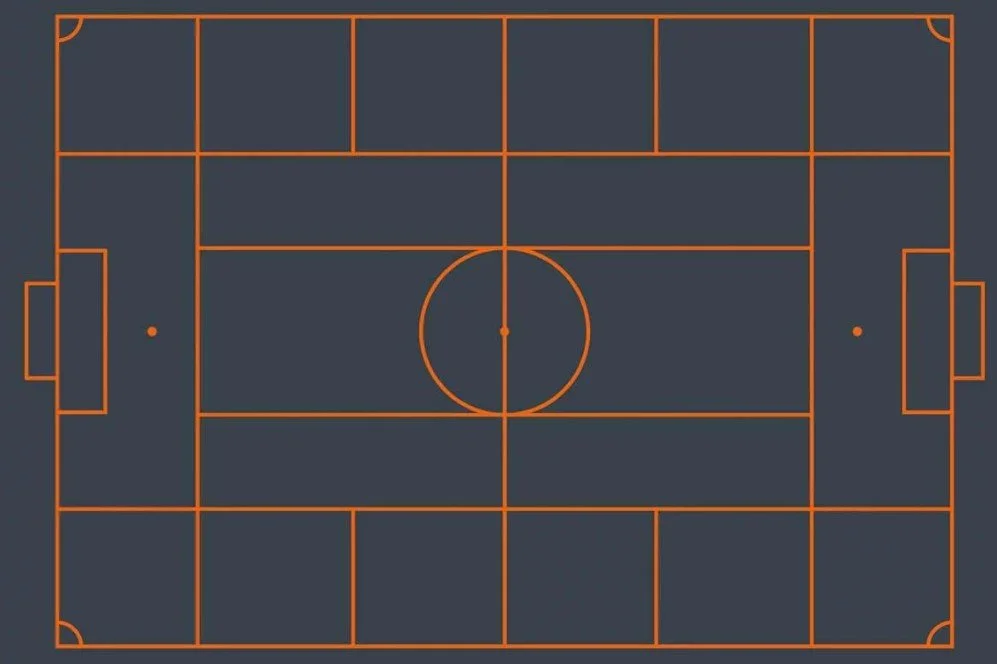
PEP GUARDIOLAS REVOLUTIONARY WAY OF LOOKING AND REFERENCING HOW HE SEES THE FOOTBALL PITCH.
Firstly, is this worth it?
A study from the University of Évora in 2017 found that a group of football players demonstrated much more cohesion and structure when white lines were painted around the edge of the pitch. Alternatively, when these lines became dashed, or were removed altogether, there was a noticeable change in behaviour, with players becoming much more individualised in their movements within a game.
So, rather than using white lines, could we use the Premier League’s regulated horizontal stripes to help create our own divided-up pitch?
After all, if we established that one stripe was four metres wide, it could aid a midfielder’s ability to recognise distances between the opposition. How many stripes are there between defensive units? How many stripes need to be behind a defensive line to know you can play beyond? When pressing, how many stripes does your team or unit need to cover? Back in my UEFA B coaching licence assessment I used flats to divide the pitch into 5 channels for an attacking rotation drill. Knowing we had to always occupy these channels, could a pitch’s style start being used in these instances?
I feel it could start acting as a proper pitch reference.
Who could benefit from it?
With the study referencing what sort of benefits it can bring, it could really suit teams that utilise specific patterns of play and play in a much more structured and rigid fashion.
Knowing that your team, in the upcoming game, wants to perform a ‘Pirlo’-like pattern, it could act as tactical geography for where and when movements need to happen:
‘Cut the ball on the third stripe, back to the edge of the second stripe, as the ST runs from the first stripe in the opposition half to the side the ball is being played.’
Additionally, the study also found that older players demonstrated a much better understanding of spatial modelling and awareness, as would perhaps be expected.
Could this also benefit young players by quickening the process of teaching those match-like instincts and spatial modelling for players who haven’t had as long to learn what a 5 yard press looks like?
Set pieces could be another area where this becomes really useful. We already go into huge detail around starting positions, runs, blocks and where we want first and second contacts to happen, so could the stripes become another reference point? Rather than asking a player to start ‘roughly five yards outside the box’, could their starting position be on the edge of the third stripe, or could we ask where we want our second-ball players positioned based on the turf mapping? It could even help with defensive restarts, ensuring distances between units remain consistent. Again, it’s not about players becoming reliant on the grass, but giving them another visual reference to help make set-piece movements more repeatable on a matchday. I have heard in some footballing situations defending wide free kicks, “everyone’s back foot on the edge of the 18” – deliberate pitch styles could provide a full map for these types of principles.
Tactical Turf Mapping
With most Premier League teams leaning towards having 18 stripes across their pitch, each third can be divided into six stripes.
We, as coaches, go to great lengths to make sure that when we play a certain opposition, the pitch we train on that week replicates our opponent’s dimensions to ensure the pictures can look as close to the real thing as possible.
But I wonder how many training pitches are designed with the same ‘tactical turf mapping’ as their team’s first-team stadium pitch?
This might be another step towards creating more alignment in tactical movements, while also making the pictures we work tirelessly to create even more accurate.
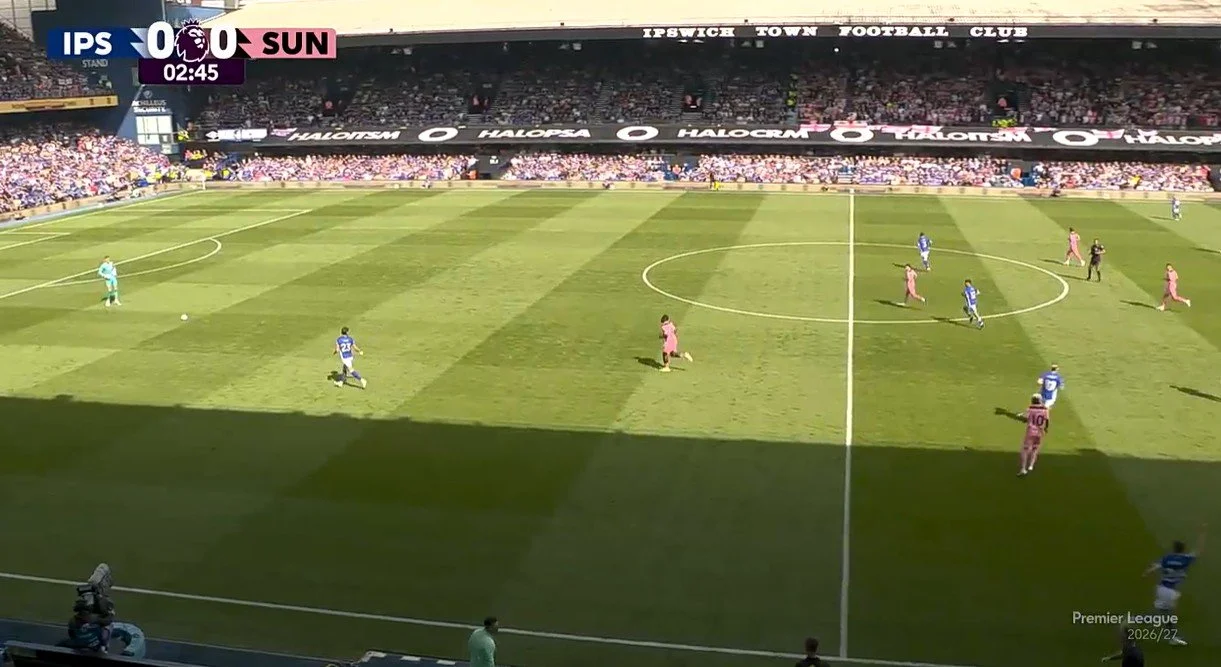
DESPITE NO OFFICIAL RULING, MOST PREMIER LEAGUE CLUBS OPT FOR 9 STRIPES EACH HALF.
I feel we could go further, though.
The Premier League Pitch Standards Framework states that pitches must not contain circles, diamonds or checkerboards. However, there is no mention of how many stripes you can use across your pitch - no mention of it having to be 18 across a pitch - meaning we could start to alter the size of these stripes and include more or fewer in certain areas.
Additionally, because of the way the grass is cut in opposite directions, it creates two different shades of green, as seen in the picture above. But could we create a third shade of green, meaning every three lines had a different colour?
I have next to no gardening or groundsperson knowledge, but I’d love to know the possibilities of this while still meeting Premier League frameworks.
Wolves were a great example last season (2025/26) as they went for having 26 stripes across their pitch, while all other 19 Premier League clubs went for the traditional 18. Allowing an easier split for the pitch to become quarters, as opposed to thirds.
Could these smaller stripes also help with decision-making under pressure, knowing you now only have one stripe - or half a standard Premier League stripe - of space?
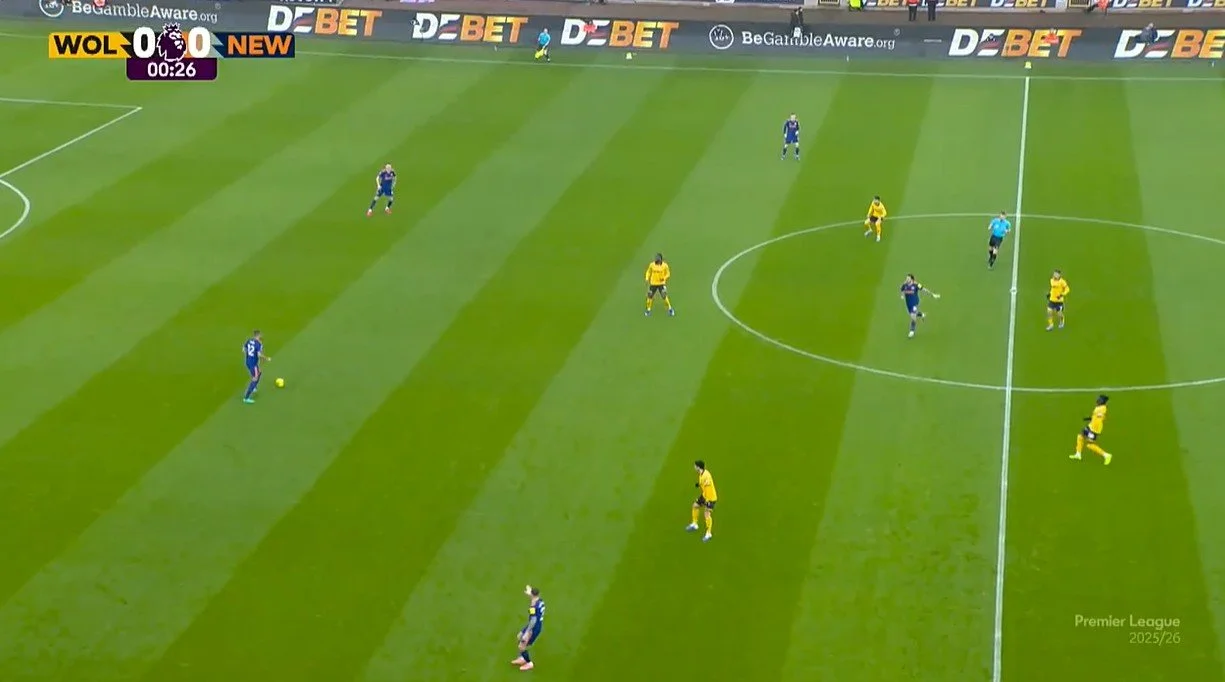
WOLVES OPTING FOR SLIGHTLY LESS WIDTH IN THEIR STRIPES AND FITTING MORE IN ACROSS A PITCH (26).
This has led to me designing a couple of other pitch drafts, each highlighting a different part of the pitch or breaking the pitch down into more coachable spaces. For example, the 5 channels, the half spaces, zone 14 or even breaking the pitch into more than just thirds.
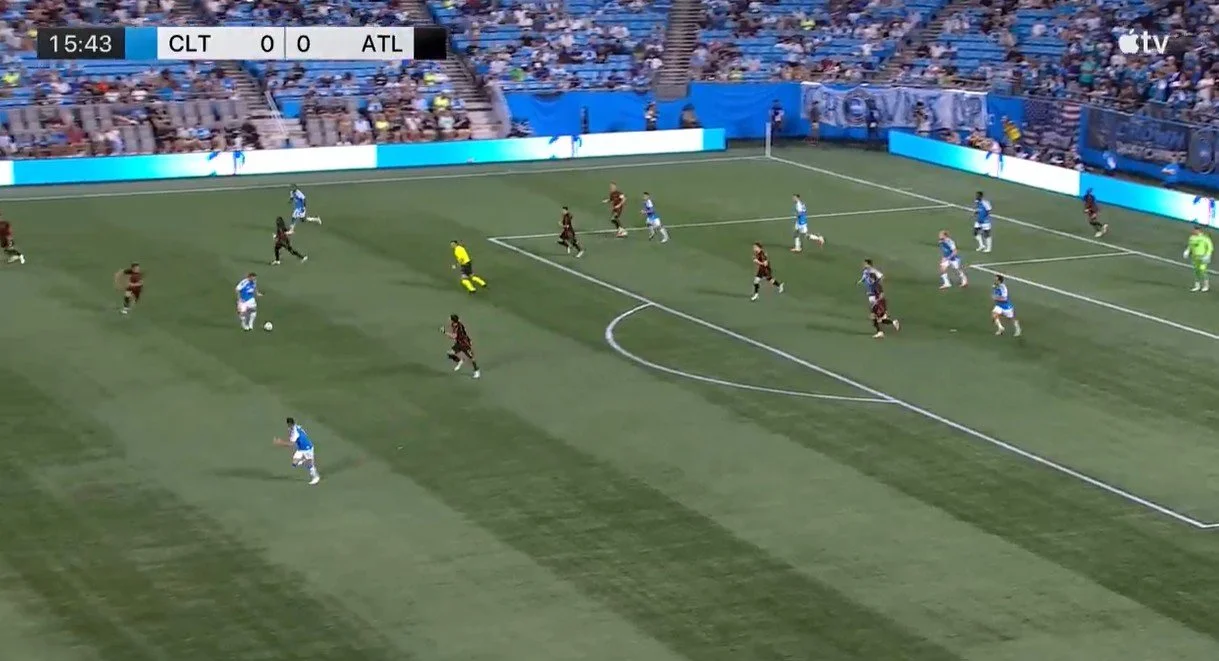
Major League Soccer sides have even less constraints have some interesting case studies. New York City FC have just 8 across the pitch, meaning each half is split into 4. Philadelphia Union have opted for 14 longitudinal stripes making the half spaces on pitch far clearer, as well as having
Charlotte FC was the most intriguing I found. They had 1 horizontal strip slightly smaller than any others, replicated at both ends and used just outside of the 18 yard area. Whether this was done deliberately or not, it would leave no illusion to players that they were in this area of the pitch and had less time. this could also potentally be used for a ‘drive and slide’ strip or even a ‘1st time finish’ strip.
i HAVE DESIGNED MANY OF MY OWN DRAFTS TO HIGHLIGHT VARIOUS PARTS OF A PITCH, AND ALSO POTENTIALS TO SUIT VARIOUS STYLES BUT SOMETHING AS SIMPLE AS THE IMAGE BELOW MIGHT BE THE START OF BEING MORE DELIBERATE WITH OUR PITCH DESIGNS.
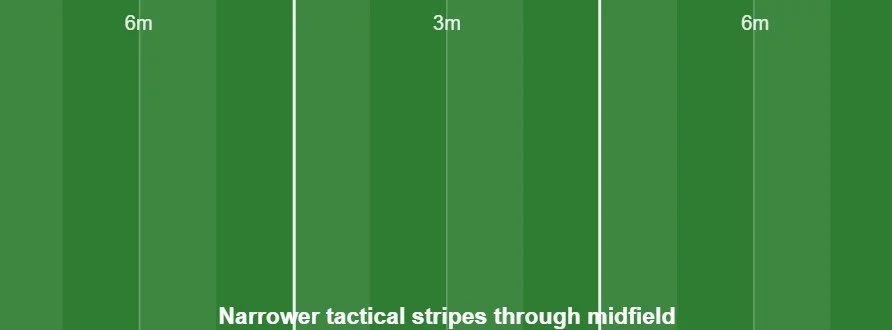
A really basic example around how we might style pitches with more purpose to aid performance or development.
Who is this better for?
Within the top leagues, some of the less restrictive pitch frameworks can be found in the Danish Superliga, Belgian Pro League and Ligue 1 or MLS.
There would be some complications around whether a team is competing in Europe, as UEFA carries its own regulations, but these leagues potentially offer much more freedom to design outside of the traditional horizontal 6-6-6 approach and even allow for longitudinal stripes.
The other opportunities are within the English Football League and non-league, where clubs have more freedom to use distinct patterns as a form of proper tactical turf mapping.
If you would be interested in collaborating to see whether this is something that could add a competitive advantage to your approach, please feel free to reach out TO me through thE website. I’d be more than happy to share some of my ideas further.
By Sammy Lander.